Dense ecosystem sees Beijing emerge as China's AI capital of page 2 | investinchina.chinaservicesinfo.com

Dense ecosystem sees Beijing emerge as China's AI capital

By CHENG YU China Daily Updated: Jun 24, 2026
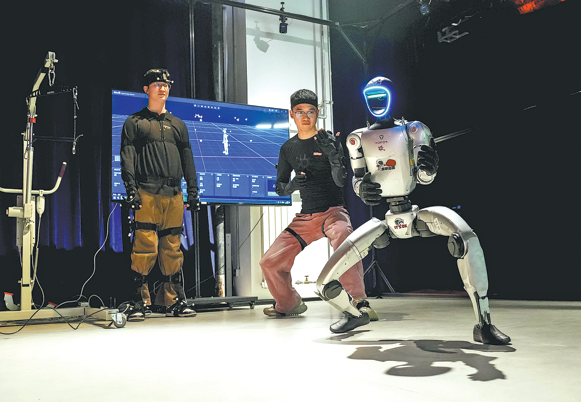
Technicians showcase a collaborative robot operated via motion capture systems in Beijing on March 26. XIE HAN/XINHUA

That ambition is already visible inside Beijing's emerging robot industry. Engineers at the Beijing Innovation Center of Humanoid Robotics are building what resembles a miniature automotive factory.

The facility serves as a pilot manufacturing and testing platform where companies can validate designs before committing to mass production. From actuator assembly and joint manufacturing to full robot integration and testing, the center covers the entire production process.

Huang Zhe, head of production at the center, said: "We can build a complete robot here in one to two days."

The pilot platform of the center became operational this year and currently has an annual pilot production capacity for about 5,000 embodied robots, Huang said.

"The goal is not simply manufacturing efficiency. It is shortening the distance between invention and commercialization," he said.

China's robotics industry increasingly faces a challenge familiar to many AI startups worldwide: moving beyond impressive demonstrations.

In another part of the city, robots are practicing tasks that appear deceptively simple. One repeatedly folds clothes. Another assembles cardboard boxes. A third attempts to tie shoelaces.

For humans, these are routine actions. For robots, they represent some of the hardest challenges in embodied intelligence.

"Clothes are deformable objects. They don't have fixed shapes. A robot can't handle them the same way it handles a solid block," said Li Yao, vice-president of Noitom Robotics.

Such exercises are not designed for household chores alone. The same capabilities are needed for future deployment in factories, warehouses and logistics centers, where robots must manipulate objects of varying shapes, textures and physical properties.

Nearby, another robot trains on a replica automotive production line. The machine picks up piston tubes, inserts them with precision, moves empty trays aside and returns for the next task.

CONTACT US

Reach out to us for information on how we can facilitate your investment journey

* Please leave a message
* Your Email Address
SUBMIT
Copyright©2026 China Daily. All rights reserved.

Dense ecosystem sees Beijing emerge as China's AI capital

By CHENG YU China Daily Updated: Jun 24, 2026
Technicians showcase a collaborative robot operated via motion capture systems in Beijing on March 26. XIE HAN/XINHUA

That ambition is already visible inside Beijing's emerging robot industry. Engineers at the Beijing Innovation Center of Humanoid Robotics are building what resembles a miniature automotive factory.

The facility serves as a pilot manufacturing and testing platform where companies can validate designs before committing to mass production. From actuator assembly and joint manufacturing to full robot integration and testing, the center covers the entire production process.

Huang Zhe, head of production at the center, said: "We can build a complete robot here in one to two days."

The pilot platform of the center became operational this year and currently has an annual pilot production capacity for about 5,000 embodied robots, Huang said.

"The goal is not simply manufacturing efficiency. It is shortening the distance between invention and commercialization," he said.

China's robotics industry increasingly faces a challenge familiar to many AI startups worldwide: moving beyond impressive demonstrations.

In another part of the city, robots are practicing tasks that appear deceptively simple. One repeatedly folds clothes. Another assembles cardboard boxes. A third attempts to tie shoelaces.

For humans, these are routine actions. For robots, they represent some of the hardest challenges in embodied intelligence.

"Clothes are deformable objects. They don't have fixed shapes. A robot can't handle them the same way it handles a solid block," said Li Yao, vice-president of Noitom Robotics.

Such exercises are not designed for household chores alone. The same capabilities are needed for future deployment in factories, warehouses and logistics centers, where robots must manipulate objects of varying shapes, textures and physical properties.

Nearby, another robot trains on a replica automotive production line. The machine picks up piston tubes, inserts them with precision, moves empty trays aside and returns for the next task.

Invest in China Copyright © 2026 China Daily All rights Reserved
京ICP备13028878号-6

京公网安备 11010502032503号