Dense ecosystem sees Beijing emerge as China's AI capital of page 3 | investinchina.chinaservicesinfo.com

Dense ecosystem sees Beijing emerge as China's AI capital

By CHENG YU China Daily Updated: Jun 24, 2026
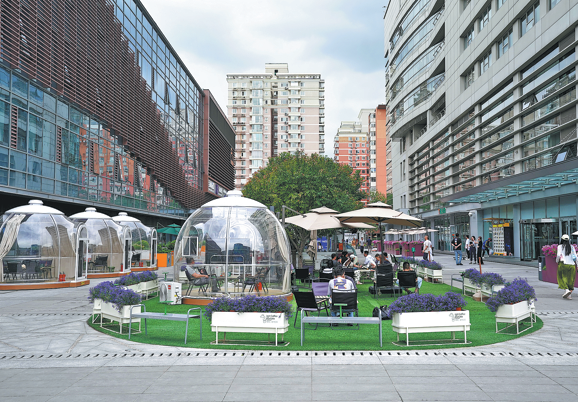
A view of the Beijing AI Genesis Community in Haidian district, Beijing, on June 10. WANG HAIXIN/FOR CHINA DAILY

The production line mirrors one at an international automotive supplier where the robot is expected to begin commercial operations later this year.

For Beijing's AI industry, the challenge is increasingly practical: not whether robots can perform impressive tricks, but whether they can generate economic value.

That shift is also reshaping how startups are built. At Zhongguancun AI North Latitude Hub, more than 100 AI startups, including one-person companies, are developing products ranging from laboratory automation systems to embodied intelligence applications.

Inside one startup, a robot learns how to grasp test tubes and dispense liquids with precision. The founder, Chen Kai, also teaches at a nearby institution. Half of his employees are his students.

The arrangement reflects another unusual feature of Beijing's AI ecosystem: the increasingly blurred boundary between universities and startups.

A three-minute walk connects the startup incubator to Zhongguancun Academy, a new education and research institution designed specifically to commercialize advanced technologies.

Students come from 31 partner universities and are selected through an unconventional process. Rather than traditional entrance exams, candidates must build AI projects within 12 hours.

The objective is not simply academic excellence.

"We want people who can solve real-world problems," Chen said.

Students work directly with startup founders, chief scientists and entrepreneurs. Many launch companies are still conducting research. The institute currently supports around 120 research and industrial projects.

"Our goal is to help students transform immature ideas into commercial products," said Dong Bin, the academy's executive vice-president.

The model reflects a broader effort by Beijing to bridge what policymakers often describe as the "last mile" between scientific discovery and industrial deployment. The strategy is also increasingly aligned with China's broader industrial priorities.

As competition intensifies globally in AI, semiconductors and robotics, Beijing's advantage may not come from any single breakthrough technology.

Instead, it may stem from concentration. Together they form a miniature supply chain covering hardware, data services, open-source frameworks, AI models and downstream applications.

For startups, proximity matters.

Sun Changku, vice-president of Quantaeye, recalled discovering a potential business partner simply by walking upstairs.

"We were working on water utility applications," he said. "Then we found another company in the building focused on the same industry. Collaboration happened naturally."

CONTACT US

Reach out to us for information on how we can facilitate your investment journey

* Please leave a message
* Your Email Address
SUBMIT
Copyright©2026 China Daily. All rights reserved.

Dense ecosystem sees Beijing emerge as China's AI capital

By CHENG YU China Daily Updated: Jun 24, 2026
A view of the Beijing AI Genesis Community in Haidian district, Beijing, on June 10. WANG HAIXIN/FOR CHINA DAILY

The production line mirrors one at an international automotive supplier where the robot is expected to begin commercial operations later this year.

For Beijing's AI industry, the challenge is increasingly practical: not whether robots can perform impressive tricks, but whether they can generate economic value.

That shift is also reshaping how startups are built. At Zhongguancun AI North Latitude Hub, more than 100 AI startups, including one-person companies, are developing products ranging from laboratory automation systems to embodied intelligence applications.

Inside one startup, a robot learns how to grasp test tubes and dispense liquids with precision. The founder, Chen Kai, also teaches at a nearby institution. Half of his employees are his students.

The arrangement reflects another unusual feature of Beijing's AI ecosystem: the increasingly blurred boundary between universities and startups.

A three-minute walk connects the startup incubator to Zhongguancun Academy, a new education and research institution designed specifically to commercialize advanced technologies.

Students come from 31 partner universities and are selected through an unconventional process. Rather than traditional entrance exams, candidates must build AI projects within 12 hours.

The objective is not simply academic excellence.

"We want people who can solve real-world problems," Chen said.

Students work directly with startup founders, chief scientists and entrepreneurs. Many launch companies are still conducting research. The institute currently supports around 120 research and industrial projects.

"Our goal is to help students transform immature ideas into commercial products," said Dong Bin, the academy's executive vice-president.

The model reflects a broader effort by Beijing to bridge what policymakers often describe as the "last mile" between scientific discovery and industrial deployment. The strategy is also increasingly aligned with China's broader industrial priorities.

As competition intensifies globally in AI, semiconductors and robotics, Beijing's advantage may not come from any single breakthrough technology.

Instead, it may stem from concentration. Together they form a miniature supply chain covering hardware, data services, open-source frameworks, AI models and downstream applications.

For startups, proximity matters.

Sun Changku, vice-president of Quantaeye, recalled discovering a potential business partner simply by walking upstairs.

"We were working on water utility applications," he said. "Then we found another company in the building focused on the same industry. Collaboration happened naturally."

Invest in China Copyright © 2026 China Daily All rights Reserved
京ICP备13028878号-6

京公网安备 11010502032503号